Gallery

Showing posts with label Bench. Show all posts

Tuesday, November 12, 2013

More Hearth Benches


I've made a series of benches that have become my best sellers at the Wake Forest Farmer's market.  These are inspired by the bench that my wife's grandfather made, see my earlier post.  The first few had legs that are octagonal in cross section, shaped on the shaving horse with only the tenon turned on the lathe.  For my recent benches I've been turning the legs and being very careful with the angles for what I think is an elegant solution. I call these hearth benches because I have one in front of my fireplace.  They also make great coffee tables or just a place to sit down and put on your boots.
White oak bench with a scalloped seat.

Ambrosia maple bench with white oak legs.

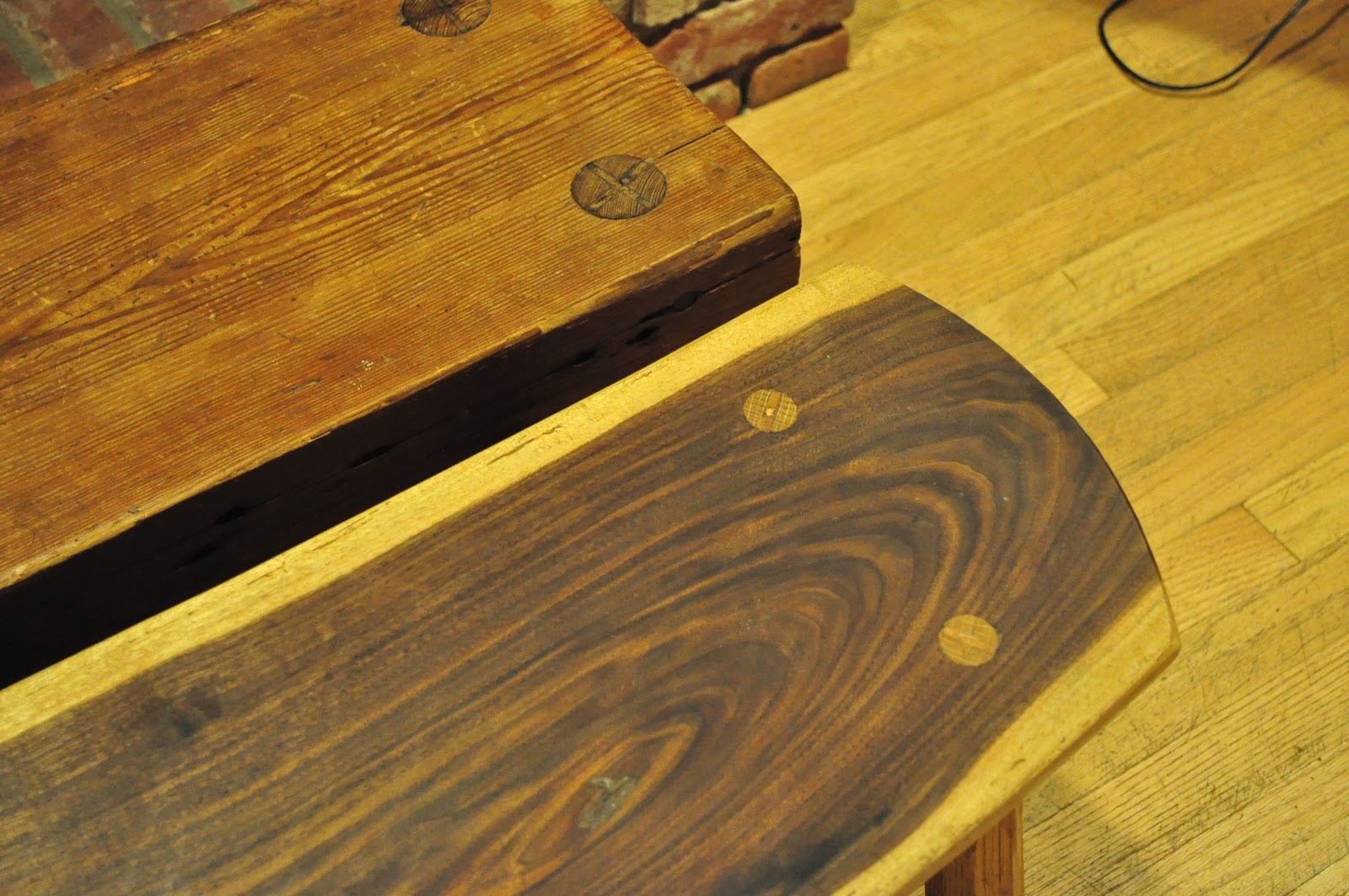
Walnut bench with white oak legs and a maple dovetail key.
The tops are 2" - 3" thick, rough sawn sections of white oak, walnut, maple or cherry often with at least one "live" edge.  I cull through my lumber suppliers stash of unusual or cast off stock that can't be milled to 8/4 s4s standards.  I'm being a bit sarcastic.  As woodworkers, we pride ourselves on precision and accumulate expensive machinery to mill boards to be flat, square and regular.  Sometimes, following that process of refinement and regularity, we end up with products made of wood that eradicate all character except the rectilinear extrusion that we made it into.  I like to leave the wood for the bench top with vestiges of it's former life and be very precise about the form, rake and splay of the tapered tenon leg.

One of my early benches in use by my family, walnut  with white oak legs.
Faceted carving on the bench top ends.
Top of the tapered tenon in the bench top.
Splits and checks when encountered in otherwise suitable wood, are also left in place.  I stabilize the splits with dovetail keys recessed into the benchtop.  This detail was utilized to great effect by George Nakashima, a great Japanese American architect and furniture maker.  I encourage you to look him up and appreciate his designs which are still being made by his family.  His philosophy that trees are noble organisms and can be given a second life in furniture is one that I can appreciate.

Maple dovetail key in a walnut bench top, stabilizing a split.


Sunday, February 3, 2013

Post and Rung Chairs Part 2

Post and Rung, or "ladderback" chairs are a familiar form, bringing to mind the elegant minimalism of the Shakers or seating at a rustic farmhouse table.  The history of post and rung chair making extends back to at least the 17th century in European examples, and the technology was brought to the New World, where it was widely used for home built seating because of it's simplicity and the longevity of it's joinery under heavy use.  This type of seating was particularly widespread in the  Appalachian and Ozark Mountain regions of the United States where English, Scotch and Irish immigrants settled.  In a previous blog post, Post and Rung Chairs Part 1, there are photographs of some examples from my own family which have endured long past their original owners.  Commercial examples of these chairs have largely ignored the principles that can contribute to an heirloom quality piece of furniture.  Most modern industrial furniture production relies on screws, braces and dowel joints in their fabrication and totally ignore wood grain direction.  I have long been fascinated with the longevity of these chairs. What follows are examples of my work in researching and fabricating post and rung chairs.


True post and rung technology makes the most of the natural properties of wood and starts with green wood which is split along the grain and shaped with these fibers aligned for maximum strength.  Care is taken to align the annual rings of the elements so that wood movement occurs as it did when the tree was a living thing.  Most of the round mortise and tenon joints overlap.  Additionally, differential moisture content of "bone dry" tenons inserted into ambient moisture mortises equalize and swell creating a locking joint.  All my chairs to date have been made of locally harvested white oak assembled with hide glue.


Everything from corn shucks, manilla rope, shaker tape, rawhide or hickory bast has been used to weave seats into ladder back chairs.  I've been using industrial hemp twine, typically used in upholstery to tie springs into place.  It's a strong natural fiber that develops a velvety texture over time.  


Many older chairs are not at all comfortable and seem purpose built to effect an upright posture.  Some elements of my chairs are steam bent to follow the curvature of the human form.
 
 
I am of course, still learning but the resulting chairs are light and resilient.  Thanks for your interest.


Hearth Bench

We have a rustic pine bench that sits in front of our hearth. It's a cherished object that provides a perch to roast marshmallows over glowing embers, or just a handy spot to sit and lace up your boots. The bench is heavily constructed of southern yellow pine and the top is a full three inches thick. It was made by my wife's grandfather who as a South Carolina contractor worked on many civic and municiple buildings. The bench top is made from a beam pulled from a building that was demolished. Blackened nail holes are still visible from the floor boards that spanned across it in a first life as a structural building element. This simple bench is valued not only because it was made by a family member and passed down as an heirloom, but also for its rugged construction, enduring the long years without failure and aquiring an amber patina along the way. I also love the aspects of the bench that give clues about its former lives, first as a living tree and then as a building beam. I can count eighty four tightly spaced growth rings in the bench top that was surely cut from a much larger log. We have some idea of its age as a bench, but who knows how long it served as a beam or who may have walked over its span. Who knows if it was harvested from a cultivated hedgerow or felled in a primeval wilderness and floated downriver to a sawmill. I like to think about these things and I've used the old bench as an inspiration for my own hearth benches.


  I've chosen to use walnut for the bench top, allowing the shape of the tree to remain, with lighter sap wood contrasting with the heartwood. The legs are white oak, split with a froe so the wood fibers remain aligned and joined to the top with a tapered tenon and wedge.Thanks for your interest.